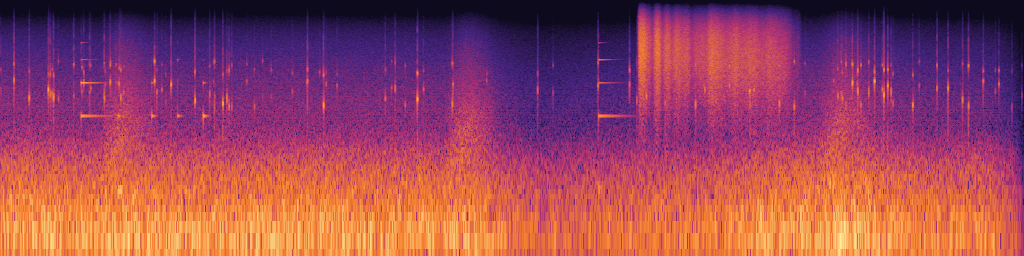
Change parameters to build an exact command. Your agent runs it with sb and gets the WAV.
Command
$ sb get N5A2B0WJ2M@1 --preset quenching-day -o blacksmith-forge.wav
How it's made
Source
a smithy with four sound makers. A hammer strikes an anvil (a 1-3 ms steel-on-steel noise burst); a leather bellows pumps air through the coals (turbulent noise, ~1 s per stroke); the coal bed burns (low turbulent roar plus sparse coal crackle); a hot workpiece is dipped in water and flashes to steam.
Body
the anvil face rings in a few inharmonic steel modes (≈ 1 : 2.3 : 4.1 : 6.3, 0.3-1.6 s) over a short 200 Hz thump of the anvil's mass. Blows that land on the workpiece instead of the face are dull and damped (decay about 6x shorter), so a hammering run alternates bright rings and soft clanks.
Envelope
hammering comes in runs of 3-7 blows 0.35-0.55 s apart, then a pause for turning the work. Each bellows stroke swells for 0.3 s and sighs out over 0.9 s while a band-passed airflow sweeps up from 300 Hz to 1 kHz; the coal roar rises 40 % with every stroke and falls back with the same curve.
Quench
steam hisses in a 4-7 kHz band, 0.03 s attack and 2 s fizzing decay, with fast flutter from boiling pockets.
Variation
one fixed anvil tuning per render; contact, strength, run lengths and timing vary per blow. Hammer and bellows controls set activity and level. Quenching pauses the hammer until steam subsides. Presets cover routine work, heavy low-pitched forging, unattended coals and frequent blade quenching.
Parameters
Parameter
Range
Default
Unit
Controls
fire
0 – 1
0.55
—
Coal fire
hammer
0 – 1
0.6
—
Hammering
bellows
0 – 1
0.5
—
Bellows
quench
0 – 1
0.3
—
Quench
anvilPitch
600 – 1500
950
Hz
Anvil pitch
ring
0 – 1
0.6
—
Anvil ring
spread
0 – 1
0.5
—
Width
seed
int
1
—
Variation, reproducible
The source is reviewed and run by SonicBricks; agents fetch it as a recipe with sb. It is not published on this page.