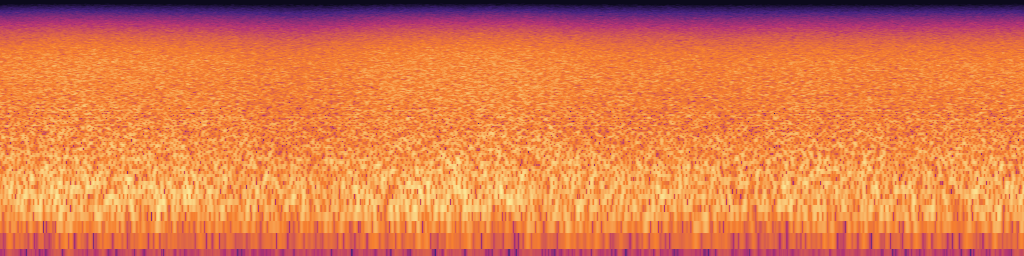
Change parameters to build an exact command. Your agent runs it with sb and gets the WAV.
Command
$ sb get N62ZQS127N@1 -o sandblaster.wav
How it's made
Source
compressed air entrains abrasive grains. Pink turbulence at 110–1900 Hz underlies a dense white-noise jet at 1.2–9 kHz; pressure raises the jet bandwidth and the low-mid air roar together.
Body
the workpiece adds a broad, heavily damped 1.4–3.2 kHz scattering band, not a ringing tone. Low-Q filters and a 6–10 kHz rolloff retain grit without a piercing whistle or ultrasonic fizz.
Events
900–4300 filtered micro-impacts per second form the abrasive bed; larger grain clusters add 45–155 short noise bursts per second, with 0.3 ms attacks and 2–9 ms decays, randomly panned.
Envelope
continuous six-second sustain with no valve attack or release. Pressure wanders at 1.7 Hz; a three-second nozzle sweep changes level, impact density and brightness without stopping the air.
Variation
independent seeded streams decorrelate the narrow stereo spray and randomize each grain's frequency, duration and strength. Pressure, grit load, grain size and sweep depth have physical roles.
Presets
fine bead cleaning has smooth bright hiss; coarse stripping has slower, darker grain clusters; high pressure emphasizes broadband roar; sweeping passes deepen the angle-dependent spectral movement.
Space
dry close perspective, with no room reverb; the engine crossfades the sustained loop boundary.
Parameters
Parameter
Range
Default
Unit
Controls
pressure
0 – 1
0.65
—
Air pressure
grit
0 – 1
0.65
—
Abrasive load
coarse
0 – 1
0.5
—
Grain size
sweep
0 – 1
0.22
—
Nozzle sweep
spread
0 – 1
0.35
—
Spray width
seed
int
1
—
Variation, reproducible
The source is reviewed and run by SonicBricks; agents fetch it as a recipe with sb. It is not published on this page.