Change parameters to build an exact command. Your agent runs it with sb and gets the WAV.
Command
$ sb get 7JB265VR6P@1 -o speaker-feedback-squeal.wav
How it's made
Source
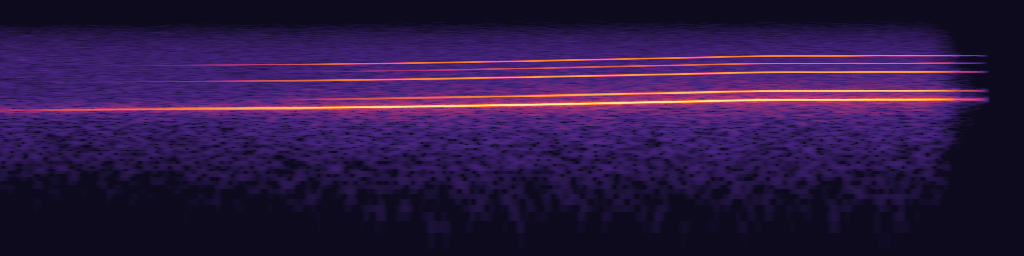
microphone noise recirculating through a loudspeaker, represented by a narrow noise seed and two phase-continuous tonal modes. This is a bounded model of feedback, not an unstable DSP loop.
Body
a 650-2600 Hz primary mode rises by 8-38 percent; a competing mode sits 1.13-1.34 times higher. The upper mode grows later as the microphone position changes; nearby modes beat in the dual preset.
Envelope
noise is audible immediately, tones emerge exponentially over 0.2-0.7 s, then compress into a sustained squeal. Pulling down the fader ends the loop with a 140 ms release and no switching click.
Layers
explicit second and third harmonics grow with loop level to model amplifier overload without unbounded distortion; a tracking Q=18 noise band and faint 0.7-8 kHz hiss retain speaker texture.
Modulation
seeded drift and 5-8 Hz flutter perturb pitch by less than one percent; slower gain flutter makes the saturated plateau breathe. A speaker low-pass rolls off energy above 8 kHz; output is dry.
Variation
seeded tuning +/-0.7 percent and flutter phase; controls set pitch, rise, competing mode, overload and instability. Presets cover low monitor howl, thin tweeter, dual-mode beating and runaway.
Parameters
Parameter
Range
Default
Unit
Controls
pitch
650 – 2600
1580
Hz
Feedback pitch
length
1.3 – 2.4
1.92
s
Feedback duration
rise
0 – 1
0.55
—
Pitch climb
competition
0 – 1
0.55
—
Mode competition
overload
0 – 1
0.58
—
Amplifier overload
instability
0 – 1
0.42
—
Loop instability
mode
upper · nearby
upper
—
Competing mode
seed
int
1
—
Variation, reproducible
The source is reviewed and run by SonicBricks; agents fetch it as a recipe with sb. It is not published on this page.