Change parameters to build an exact command. Your agent runs it with sb and gets the WAV.
Command
$ sb get TPQCQTZ4ZA@1 --preset rapier -o sword-clash.wav
How it's made
Source
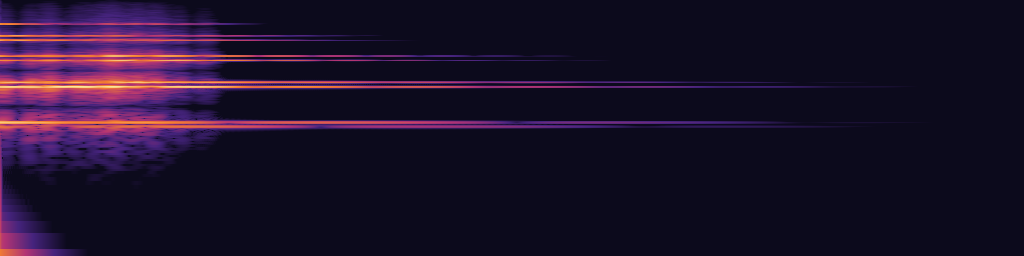
two steel blades meeting edge to edge. Contact lasts about 1 ms, so each blade is excited by a broadband, high-passed click; the second blade is struck a few ms later and slightly off axis, which doubles the transient into a sharp "tk-tch". A short scrape follows as the edges slide past each other.
Body
a thin blade is a free-free bar. Its flexural modes are inharmonic, at about 1 : 2.76 : 5.40 : 8.93 : 13.3 times the lowest mode (300-1100 Hz). Steel is lightly damped, so the lowest modes ring for up to `ring` seconds while the upper ones die within 0.1-0.3 s. The two blades differ in length and stiffness (`mismatch`), so their mode sets interleave and beat against each other instead of reinforcing.
Scrape
band-passed noise whose centre rises from 2.5 kHz to 6 kHz over about 0.3 s, shaped by a rough random amplitude (stick-slip friction) and a fall in force. It also feeds the blade modes, so the sliding noise picks out the metallic resonances instead of sounding like a bare hiss.
Envelope
instant attack, exponential decay per mode (T60 up to `ring`, 1 s by default); the output is closed by a fade after the longest mode, so the one-shot ends at about 1.2 s.
Variation
`rng` mistunes every mode by up to 0.6 %, varies the click and the friction texture. Macros: `pitch` is blade length and mass, `brightness` the strength of the upper modes, `scrape` the amount of sliding contact, `mismatch` the tuning gap between the blades.
Parameters
Parameter
Range
Default
Unit
Controls
pitch
300 – 1100
620
Hz
Blade pitch
ring
0.4 – 1.3
1
s
Ring time
brightness
0 – 1
0.55
—
Brightness
scrape
0 – 1
0.5
—
Scrape
mismatch
0 – 1
0.4
—
Blade mismatch
hardness
0 – 1
0.7
—
Strike hardness
seed
int
1
—
Variation, reproducible
The source is reviewed and run by SonicBricks; agents fetch it as a recipe with sb. It is not published on this page.