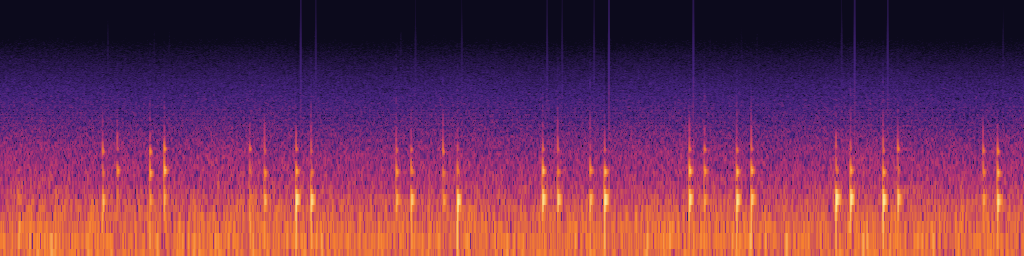
Change parameters to build an exact command. Your agent runs it with sb and gets the WAV.
Command
$ sb get H678X700J5@1 --preset night-sleeper -o train-carriage-interior.wav
How it's made
Source
steel wheels running over rail joints. Each wheel hitting the gap is a 1–3 ms broadband tick plus a 20–60 ms low thud (80–200 Hz) that the carriage floor and frame carry into the cabin. Between joints, wheel and rail roughness and the air flow make continuous low noise.
Rhythm
a bogie has two axles ≈ 2.5 m apart and a carriage two bogies ≈ 17 m apart, so every rail joint (≈ 25 m apart) gives a clack-clack pair, a gap, then a second pair. The joint rate sets the train speed; the period is snapped to a whole number of joints so the 12 s loop holds complete patterns.
Body
the floor and wall panels ring in a few damped modes (≈ 150, 310, 540 Hz, 60–140 ms) under each clack. Loose panels and fittings answer with a short, dry rattle burst (0.6–2.5 kHz, 0.1–0.25 s) after every clack, plus a faint sparse rattle between them.
Envelope
the rumble is a steady brown-noise floor under 140 Hz and a 90–900 Hz roar, swaying ±12 % at 0.3–0.5 Hz as the body rocks on its springs; nothing else changes over the loop.
Variation
`rng` jitters joint timing (±4 ms), clack strength, tone, and every rattle burst. The parameters set speed, rumble weight, clack hardness, rattle amount and cabin muffling.
Parameters
Parameter
Range
Default
Unit
Controls
speed
0.5 – 1.8
0.85
Hz
Rail joints passed per second: the train speed
rumble
0 – 1
0.6
—
Rumble
clack
0 – 1
0.6
—
Clack
rattle
0 – 1
0.4
—
Panel rattle
muffle
0 – 1
0.4
—
Muffling
sway
0 – 1
0.4
—
Body sway
spread
0 – 1
0.7
—
Width
seed
int
1
—
Variation, reproducible
The source is reviewed and run by SonicBricks; agents fetch it as a recipe with sb. It is not published on this page.