Change parameters to build an exact command. Your agent runs it with sb and gets the WAV.
Command
$ sb get Q3D6YA6VZZ@1 --preset tumbler -o ice-cubes-in-water-glass.wav
How it's made
Source
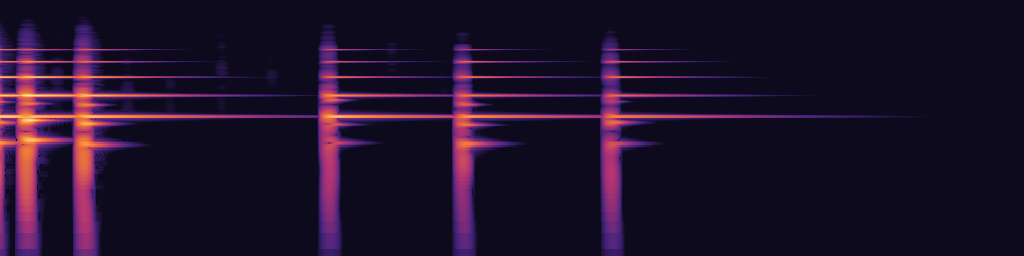
1–6 ice cubes enter water over 0–450 ms. Each contact excites the glass with a rounded 0.5 ms attack / 3 ms noise pulse; ice-on-ice contacts have softer 1 ms attacks and 20–90 ms damped bodies, rather than sustained musical notes.
Body
the water-loaded glass has inharmonic modes near 1.25, 2.13, 3.37, 4.96 and 6.71 kHz, scaled by vessel size. T60 is 0.18–0.72 s, with upper modes dying first. Each glass keeps the same modal tuning across its contacts. Ice knocks use independently detuned 650, 1120 and 1870 Hz modes, T60 40–95 ms.
Water
12–85 ms band-limited noise splashes open after entry; their low-pass cutoff falls from 6.5 to 1.4 kHz. Entrained 1.2–3 mm bubbles add short rising chirps 18–85 ms later, kept behind the clinks. No room reverb is baked in.
Envelope
the initial impacts give way to weaker buoyancy-driven contacts at 0.62–1.18 s. Sparse 2–8 ms ice crackles fade over 0.95 s. All layers taper to zero by 1.98 s, followed by a silent safety margin.
Variation
named seeded streams vary impact spacing, strength, ice tuning, bubble radius and narrow stereo position. Cube count changes event density; vessel controls glass pitch, ring controls damping, water controls splash balance, and fracture controls fine crackles. Presets cover a large single cube, a typical tumbler, a crushed-ice handful and a delicate thin highball.
Parameters
Parameter
Range
Default
Unit
Controls
cubes
1 – 6
3
—
Cube count
vessel
0 – 1
0.5
—
Vessel size
ring
0 – 1
0.45
—
Glass ring
water
0 – 1
0.5
—
Water splash
fracture
0 – 1
0.35
—
Ice crackle
seed
int
1
—
Variation, reproducible
The source is reviewed and run by SonicBricks; agents fetch it as a recipe with sb. It is not published on this page.